Preteens & Teens
Why Should I Vaccinate My Preteens and Teens?
Preteens and teens are at increased risk of getting certain vaccine-preventable diseases as they engage in common activities such as sharing drinks and utensils, kissing, attending summer camps, and later, college. As your children become preteens, some vaccines they received as infants and young children begin to wear off and they need a “booster dose.” Other vaccines are recommended for children starting at ages 11 or 12 to keep them healthy into adulthood.
Missed well-care and vaccination visits can leave your children unprotected from dangerous diseases. Preteens and teens do not have as many regular visits with healthcare providers and may miss critical vaccines that can protect them.
Fewer cases of cervical cancer are being reported in the UK thanks to widespread HPV vaccination.
Why Follow the Recommended Vaccination Schedule?
The childhood immunization schedule is carefully designed to protect children and adolescents when they are most vulnerable to serious disease and when vaccines will produce the strongest immune response. They consider the number of doses needed, appropriate timing between doses, and any precautions for specific populations.
Vaccinate Your Family eBook
Vaccines are so effective that many of us don’t remember seeing the diseases they prevent. Learn more about preteen and teen vaccine-preventable diseases with our downloadable booklet.
To Find a COVID-19 Vaccine for Your Preteen/Teen:
- Check with your child’s healthcare provider about whether they will offer COVID-19 vaccination
- Check your local pharmacy’s website or call to see if vaccination is available
- Contact your state or local health department for more information
More Information
- Vaccinate Your Family: COVID-19
- HealthyChildren.org (from AAP): Getting Your Child Ready for the COVID-19 Vaccine
- HealthyChildren.org (from AAP): The Science Behind the COVID-19 Vaccine: Parent FAQs
- CHOP Vaccine Education Center: Questions & Answers about COVID (Children’s Hospital of Philadelphia)
- LetsGetRealAboutVaccines.org: COVID-19
Yes. The AAP says that it is okay for your preteen and teen (12 years old or older) to get their routine vaccines at the same time as the COVID-19 vaccine.
See the child and adolescent recommended schedule and ask your child’s healthcare provider which vaccines are recommended at each check-up, including the seasonal COVID-19 vaccine.
It depends on which state you live in.
Learn more about this issue in an episode of PBS’ Above the Noise with host Myles Bess. In this video, Myles investigates the trend of teens wanting to get vaccinated without parental consent, in addition to the history of vaccines and the movement against them. He also speaks with Kelly Danielpour, a high school senior who founded VaxTeen – an organization that provides resources for teens to learn more. Watch now.
More Info
- Read Ethan’s informed choice story
- Vaccinate Your Family: Paying for Vaccines Online Tool
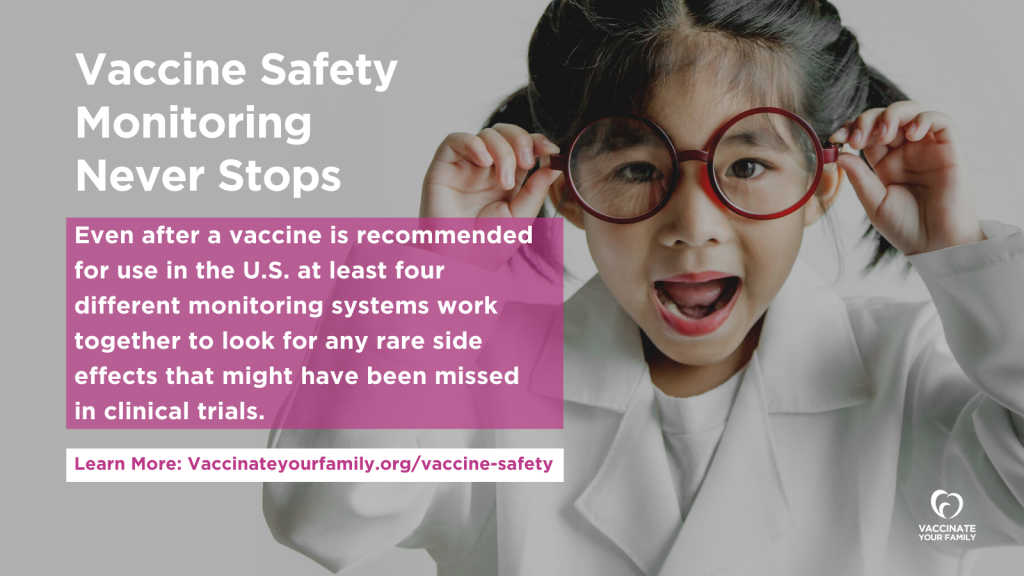
Vaccines approved for use in the United States are required to go through three phases of clinical trials and years of extensive safety testing before they are approved (or authorized) by the Food and Drug Administration (FDA).
After approval or authorization, each vaccine continues to be continuously monitored for any safety. This monitoring looks for any rare or new problems that may happen after vaccination.
In the US, there are five different vaccine safety surveillance systems in place to watch routine vaccines AFTER they are approved and recommended.
- Vaccine Adverse Events Reporting System (VAERS)
- Vaccine Safety Datalink (VSD)
- Clinical Immunization Safety Assessment (CISA) Project
- Biologics Effectiveness and Safety (BEST) System
- V-safe
Any serious safety problems found with these vaccines will be reported to health officials, healthcare providers, and the public.
What about the Safety of COVID-19 Vaccines?
Unprecedented times called for a quick turnaround of safe and effective COVID-19 vaccines. While steps to develop the vaccines were streamlined or overlapped, none of them were skipped. Vaccine safety was—and continues to be—a top priority in all phases of vaccine development (clinical trials), authorization/approval, and post-authorization/post-approval monitoring.
Learn more about the development process of COVID-19 vaccines in this short video .
Please see our COVID-19 page for more on COVID-19 and vaccination.
Yes, the HPV vaccine is very safe and effective at preventing HPV. The only HPV vaccine used in the US is called Gardasil 9, and it protects against the nine most dangerous strains of HPV. The vaccine underwent years of testing on thousands of people in clinical trials to ensure it was safe. After licensure, the vaccine was continuously monitored for safety through the US post-licensure vaccine safety surveillance systems to identify rare or new problems that may occur after vaccination. Since HPV vaccine became available in 2016, there have been many large safety studies conducted in the US and other countries. HPV vaccines continue to have good safety records, and careful safety monitoring.
Of course, vaccines, like any medicine, can have side effects. Many people who get the HPV vaccine have no side effects at all, while others report having very mild side effects, like a sore arm from the shot. The most common side effects of HPV vaccine include:
- Pain, redness, or swelling in the arm where the shot was given
- Fever
- Headache or feeling tired
- Nausea
- Muscle or joint pain
There have been some reports of fainting after HPV vaccination, which is not usual. Sometimes people, especially teens, faint after they get shots. To make sure your child doesn’t get injured if they fall from fainting, your healthcare provider might ask your child to stay seated after getting the vaccine to help protect him/her.
No, there is no evidence that HPV vaccination causes fertility or reproductive problems. In fact, getting HPV vaccine, which protects against cervical cancer, can help ensure a woman’s ability to get pregnant and have healthy babies.
For example, a woman who develops cervical cancer later in life due to HPV infection may require serious treatments that could leave her unable to have children. It’s also possible that treatment for cervical pre-cancer could put a woman at risk for problems with her cervix, which could cause preterm delivery or other problems. HPV vaccination can help prevent these complications.
There have been scientific studies that have looked at this issue, and they show that there is no correlation between receiving the HPV vaccine and increased rates of, or earlier engagement in, sexual activity.
Like all vaccines, we want to give the HPV vaccine earlier rather than later— before your child is exposed to HPV. Preteens should receive all recommended doses of the HPV vaccine series long before they begin any type of sexual activity. Even if your child delays sexual activity until marriage, or only has one partner in the future, he or she could still be exposed to HPV if his/her partner has been exposed to HPV. Studies have shown that the HPV vaccine is most effective in preventing the virus and, therefore, HPV-related cancers when given at age 11 or 12 (as young as age 9).
There are three meningococcal vaccines available in the United States. These vaccines protect your child against different serogroups (strains) of meningococcal disease. Meningococcal conjugate vaccine (MenACWY) is routinely recommended for preteens and adolescents to protect against four serogroups (A, C, W, and Y).
Serogroup (B) meningococcal vaccine (MenB) protects against serogroup B and is available for young adults 16 through 23 years old.
There is also a meningococcal vaccine that protects against all common serogroups in a single dose, called MenABCWY, and is available for individuals ages 10 to 25.
Ask your child’s doctor about having your child vaccinated against meningitis.