Charlie
A Flu Story
Place of Residence: St. Louis, Missouri
As a healthy adult, Charlie never expected to get severely ill from the flu in his 30s. After being hospitalized for 58 days, he wants others to know why vaccination matters.
Read Charlie’s story below.
How would you describe yourself? What are some of your favorite things to do?
I’m a professional political nerd who works in government affairs. My hobby has always been politics. In the last couple of years, I’ve started learning the bass guitar, which has been fun. I suck at it, but I’m having a good time.
When did you get sick with the flu?
In January 2018, I came home from a conference on a Friday afternoon and started feeling sick. The following Tuesday, I went to the doctor and tested positive for influenza A. By this point, my wife had started feeling sick and tested positive too. Because she was still within the 48-hour window, she was able to receive flu antiviral medication, but it was too late for me.
By Thursday, my symptoms kept getting worse, so I went back to the doctor. When the nurse practitioner examined me, she saw signs of sepsis, a life-threatening immune system reaction to an infection, so she sent me to the emergency room (ER). The doctors at the ER apparently didn’t see what she did and sent me home.
The following day, my symptoms continued to worsen and by early Saturday morning, I went back to the ER. Within 15 minutes, doctors put me in a medically induced coma to protect my brain and vital organs. The last memory I have of that day, and for the two weeks that followed, is the nurses placing an IV in my arm.
How did your illness progress?
What started as the flu turned into pneumonia, which turned into sepsis, which turned into septic shock and organ failure. While in a coma, I was intubated and placed on a ventilator, which is a machine that helps people breathe. My kidneys stopped working, so I was placed on dialysis, a treatment that removes excess fluid and waste from the blood when the kidneys are unable to.
My heart was struggling too, and I had been scheduled to begin extracorporeal membrane oxygenation (ECMO), a last resort commonly known as “life support.” The doctors did not expect me to survive and told my wife to start planning my funeral.
Thankfully, I turned a corner and started improving, so I no longer needed ECMO. I woke up a week and a half later and had no memory for two days. Apparently, the nurses had to explain what happened to me repeatedly because I kept forgetting. At this point, I was still unaware of the severity of my illness, and I didn’t know I was still at death’s door.
The first memory I have is from that following Thursday, just about two full weeks later. I vividly remember feeling overwhelmed by what had just happened and the outpouring of love and support I received during that time.
What was your recovery like?
From the moment I woke up from the coma, I made slow but steady progress. Without question, new challenges arose that the doctors had to balance, and I experienced a lot of ups and downs. I ended up being hospitalized for 58 days and was in the ICU or the ICU step-down unit the entire time. My recovery was a relatively straightforward progression where things kept getting better, but it took a long time.
 While in the hospital, I had three drainage tubes placed, multiple surgeries, a feeding tube, and developed an ulcer on my esophagus. I lost 40 pounds, a lot of that muscle, and my esophagus atrophied, which means the muscles that help me swallow weakened from lack of use.
Once I woke up from the coma, it took a while before I was even strong enough to stand. Then I had to walk with a walker, slowly building up my strength so that when I was back home, I would be able to walk unassisted.
After being released from the hospital, I spent 3 weeks in the same nursing facility as my grandmother, which was an experience I never saw coming. I called it a “twofer,” since my family could visit her and me at the same time. Two days before my 39th birthday, I was discharged from the facility and finally went home.
Overall, my recovery took about a year. Before I even started my part-time return to work, I had at-home nursing care and physical therapy. I returned to work full-time in August, but it was a slow progression for six months before then. By September, life looked more normal, but I still had a lot of rebuilding I had to do, especially for my physical strength and endurance. It took around 12 months before I reached my new normal.
"Hundreds of thousands of people get very ill from flu every year—you don’t want that to be you or a family member."
Do you have any long-term health issues as a result of your illness?
The medications the doctors gave me to save my life caused permanent hearing damage in my right ear. I also had testing done that showed some scarring on my right lung.
There are other lingering issues that we’re still trying to figure out, which cause me to choke and vomit up phlegm some mornings. It takes me a long time to get ready in the morning, because I have to sit and rest. I didn’t have these problems before; that’s the legacy of surviving the flu.
Influenza really took a toll on me physically, to the point where I have still not been able to build back the endurance and strength that I lost. Even though I look totally normal, there are still things people don’t see that impact me every day.
How did your illness impact your family?
I think it was harder on my family than it was for me. While I was still in the coma, my dad and brother flew in to say goodbye. Then for weeks, my mom, my dad, and my wife were on an eight-hour rotation, each of them taking shifts so someone was with me 24/7. They had to watch helplessly throughout the whole experience as I fought for my life.
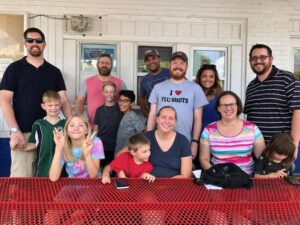 The year of my illness, I hadn’t received a flu shot, and to my knowledge, I had never received a flu shot as an adult before. I figured it was something that the young and the elderly needed but not normal healthy adults. I very nearly paid the price of not getting vaccinated with my life. My family and I all get our flu shots now.
Every flu season, people now text me in September or October saying, “Got my flu shot!” in part because of the advocacy I’ve done. I’m a cautionary tale—I learned the hard way that flu can be serious, but hopefully I can use my story to help prevent the same experience for other people and their families.
What do you want other people to know about the flu?
Influenza is nasty. It’s an illness we underestimate. Prevent flu for yourself, because you don’t want to go through this, and prevent flu for your loved ones, because you don’t want them to go through this. Prevent flu for folks who are immunocompromised and those who can’t get the vaccine for medical reasons. It’s critical for herd immunity that more people get vaccinated.
We also need to protect our hospital system. I am still here because of some remarkable doctors and nurses, but let’s not put strain on them if we can avoid it, too.
What would you say to someone who is hesitant about getting vaccinated?
I had to get a shot in my stomach every eight hours in the hospital to prevent blood clots. I don’t recommend that. Getting one shot once a year is way better. The amount of pain and suffering that a quick vaccination can prevent is absolutely worth it. It’s one shot that might make your arm sore for a day or two. But the alternate is tens of thousands of people dying from the flu every year, and I don’t think people take that seriously enough.
Protect yourself. Protect your family. And if you have concerns, talk to your doctor or your pharmacist. If you have questions, just ask.
BECOME A VACCINE ADVOCATE
There are lots of ways you can make a difference in your community.


Have you or a loved one been impacted by a vaccine-preventable disease?
Or would you like to simply share why you choose to vaccinate?
We want to hear from you!