Hunter
An RSV Story
Place of Residence: Brooklyn, New York
Hunter was 6 months old when he contracted respiratory syncytial virus (RSV) in October of 2022. Initially, his parents struggled to find care until he developed pneumonia and landed in the ER.
Hunter’s parents, Frederick and Kaylee, share his experience with RSV and explain how his illness impacted their family.
How would you describe Hunter? What was he like as a baby?
Hunter was a very good baby. He barely cried, and it was simple and easy with him. We were in the stage of introducing new foods and he always ate what we prepared for him, when we prepared it for him. It was like clockwork with him, so when he stopped eating one day in October 2022, we knew something was wrong.
 How did Hunter get RSV?
 How did Hunter get RSV?
 No one really knows how Hunter got RSV. We were very careful to keep him away from people who were sick, and our family felt fine, so we were shocked and confused that he got it.
The doctors told us Hunter must’ve been around someone who had it, perhaps unknowingly, and they unfortunately gave it to him. Everyone blamed themselves—it was scary because there was no way for us to prevent RSV back then.
What were Hunter’s symptoms?
In October of 2022, we had organized a small party for Hunter to celebrate him turning 6 months old. We expected him to love the cake we picked out because it was fun and colorful, but he didn’t even want the birthday cake, which was very unlike him. He was fussy and acted like he was getting sick, so we took him to the doctor.
At the pediatrician’s office, we were told that they couldn’t test him for illnesses like flu and RSV because he wasn’t showing any respiratory symptoms. They said that he probably had a cold and sent us home, and we felt that they were very dismissive of our concerns.
RSV is not just a cold. If you feel that something is wrong with your child, trust your instincts.
How did you know his illness was serious?
About four hours later, Hunter started having labored breathing. We took him to urgent care where they swabbed him for flu, COVID-19, and RSV—everything they could. That’s when he tested positive for RSV.
Since there’s no treatment for RSV, we were sent back home. But around 10 o’clock that night, Hunter’s breathing got worse—he started gasping for air. We rushed to the emergency room (ER) where they noticed his oxygen levels were very low and found he had pneumonia. They also did blood work that he did not take well. Hunter cried so hard that he passed out during the process.
How did his illness progress?
 How did his illness progress?
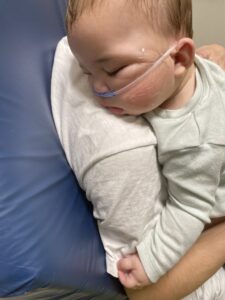
The doctors prescribed Hunter a breathing device and medicine to help with the pneumonia. As I’m sure you can imagine, the device was very difficult to use for a 6-month-old baby who did not want to have anything on his face. But it was helpful for Hunter’s recovery from pneumonia and RSV.
The recovery process was strangely slow. Normally, with an illness like a cold, you would think you would feel better in a week. However, it took Hunter over a month of using the device and medicine for his breathing to become more normal. We also had follow-up appointments with doctors over the course of several months to check on his recovery process. It took months before his lungs and blood work returned to normal.
How did Hunter’s illness impact your family?
Hunter had difficulty breathing for over a month, which meant he also had difficulty sleeping. Sometimes when he slept, it sounded like he was drowning because he couldn’t catch his breath. We had to sit with him in steam showers to try to help break up all the mucus blocking his airway. There were a lot of long, sleepless nights.
One unexpected aspect of Hunter’s experience with RSV is that before his illness, he used to babble a lot. But after he caught RSV, he was a lot quieter. It took a long time for his outgoing personality to return. He went back to eating, sleeping, and bath time, but it took a while before he started babbling and wanting to talk more again. We had missed seeing that side of him.
What do you want other people to know about RSV?
Our concerns as parents were not taken seriously by the first doctors we went to that day. Although it was scary to be in the ER, we were grateful to the doctors there who believed us and quickly stepped in to take care of Hunter. I want young parents to know it’s important to make sure your voice is heard. RSV is not just a cold. If you feel that something is wrong with your child, trust your instincts.
BECOME A VACCINE ADVOCATE
There are lots of ways you can make a difference in your community.


Have you or a loved one been impacted by a vaccine-preventable disease?
Or would you like to simply share why you choose to vaccinate?
We want to hear from you!