The Danish Vaccine Schedule Protects Babies and Children from Fewer Diseases Than in the United States
This post is part of our series covering hot topics from the recent Advisory Committee on Immunization Practices (ACIP) meetings and related announcements. For further reading, check out this post about aluminum and its safe use in vaccines.
Why is the Danish vaccine schedule being held up as an example by vaccine decision-makers in the U.S., and should we use it to make changes to our own vaccine recommendations?
Let’s break down what we know about the schedule used in Denmark and why the U.S. health care landscape is different.
Differences Between the U.S. and Denmark Childhood Immunization Schedule
Comparing the CDC immunization schedule as of October 2025 to the schedule used in Denmark, the Danish schedule recommends vaccinating against fewer diseases than in the U.S.
Their schedule does not include seasonal respiratory vaccines, like respiratory syncytial virus (RSV), COVID-19, or influenza for children. They also do not recommend vaccinating against hepatitis B for all infants, nor hepatitis A, rotavirus, and varicella (chickenpox) for any infants and children, and meningococcal for adolescents.
Learn more about the hepatitis B birth dose and its important role keeping babies in the U.S. safe from chronic illness here.
At first glance, this raises the question: why do we need all these vaccines in the U.S. if other countries, including countries like Denmark which has better overall health outcomes, do not? In short – the United States isn’t Denmark! There are some significant differences between the U.S. and Denmark, which is why each nations’ vaccine recommendations have been independently created to best fit the health needs of their populations.
Here are a few key differences between Denmark and the U.S. and their healthcare systems:
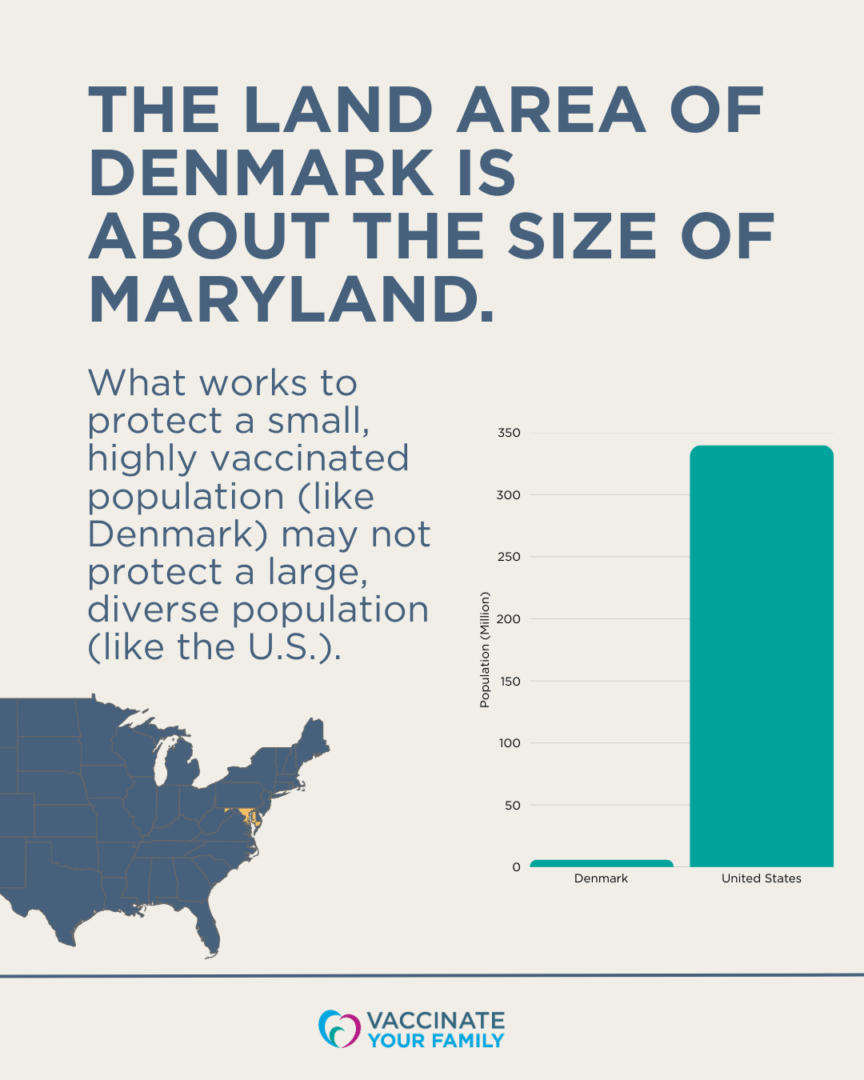
- Denmark’s population is much smaller than the U.S. – only about 6 million people, comparable in size to the population of Wisconsin or Colorado. The U.S. population is 57x the size of Denmark, with more than 340 million people. What works to protect a small, highly vaccinated population (like Denmark) may not protect a large, diverse population (like the U.S.).
- Denmark is a physically small country, with a land area similar to the state of Maryland. The U.S. land area is more than 300x the size of Denmark.
- In the U.S., a much larger population covering a much larger area means we are faced by more and different infectious disease threats.
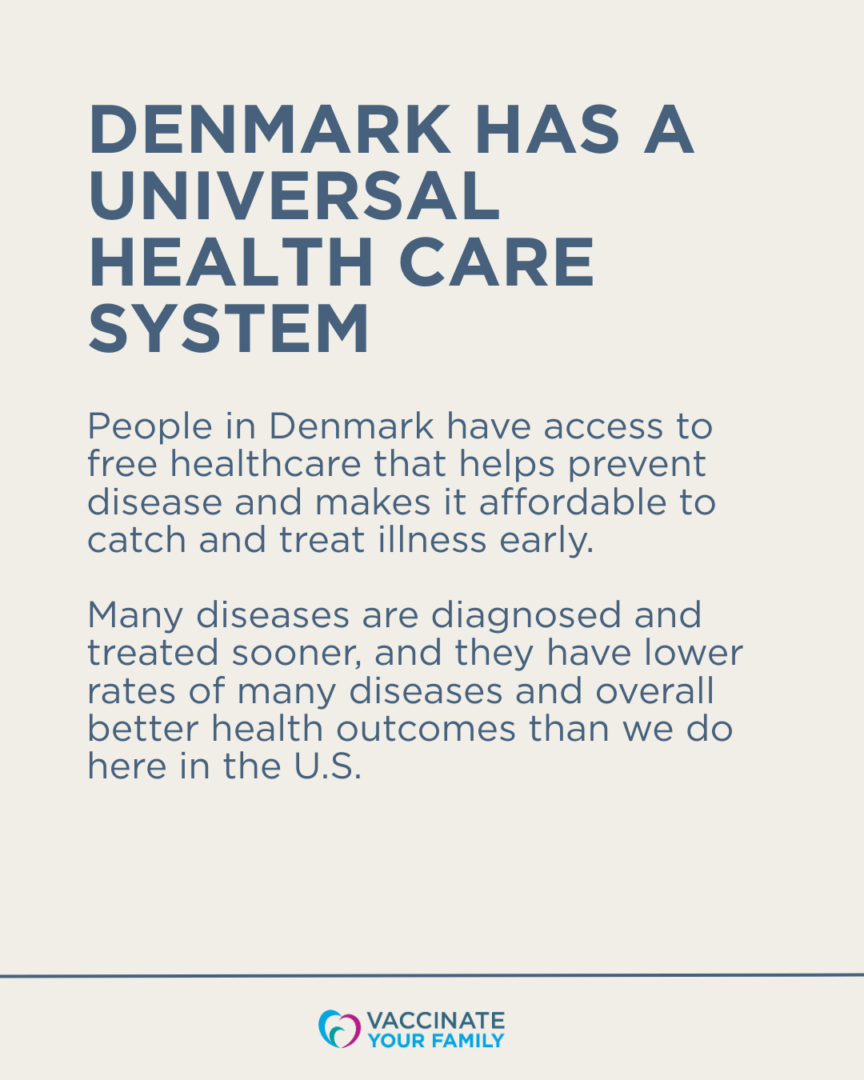
- Denmark has a universal access health care system that means residents have free comprehensive health services, but in the U.S., we have a fragmented multi-payer system. Because of this, Denmark has increased ability to test people for illness, treat disease earlier, and care for the health of their population much more consistently and equitably than the U.S. They have a much more robust maternal/child follow-up program for babies and new moms, with more frequent, guaranteed touchpoints for care.
Even so, Denmark has higher rates of some dangerous diseases because of their vaccination program.
In the U.S., because varicella (chickenpox) is a routine childhood immunization, there are less than 150,000 cases and 30 deaths annually. However, in Denmark, where there is no national chickenpox vaccination program, the estimated annual number of cases is 60,000 per year. Remember, the U.S. is a much larger country than Denmark, so this is a much higher rate.
These cases strain the healthcare system and increase the risk of hospitalization, especially for children and babies with underlying conditions.
The U.S. childhood immunization schedule has been carefully and thoughtfully created over time to best protect babies and children here in the U.S. from the diseases they are at risk of encountering here.
While other countries may use different schedules, those decisions are based on their own disease patterns, health systems, and population needs. Denmark does not face the same levels of vaccine-preventable diseases, nor does it have the same demographic diversity, health disparities, or rates of community spread seen in the United States. Comparing the two schedules is like comparing apples and oranges: each is designed for a different context.
Relying on another country’s schedule to guide decisions in the U.S. ignores the unique risks American children face and could leave them vulnerable to diseases that are still circulating here. The U.S. schedule reflects the best available science for our population and our healthcare system—and changing it without U.S.-specific data would put children at unnecessary risk.
Denmark has contributed important research on vaccine safety and benefits.
While we shouldn’t base our schedule on the schedule of another country, that doesn’t mean we can’t learn from them. Because of their integrated national healthcare system, researchers from Denmark can provide a wealth of vaccine safety and effectiveness data.
From Denmark’s immunization program, we have learned about the high effectiveness of the human papillomavirus virus (HPV) vaccine in preventing cancer-causing strains of HPV.
A large study in Denmark also found that there is no link between childhood immunization and 50 different health conditions, including asthma and autism. While it’s true that our schedules are different and this study cannot be applied to the U.S. schedule wholesale, it provides strong supporting evidence for the safety of vaccines broadly as related to long-term health outcomes.
Learn more from Dr. Jake Scott on the methodology and results of this landmark study here.
America’s childhood immunization schedule has been designed to protect infants and children as early as possible from different diseases to keep them healthy. These diseases can affect our families in many ways–from a missed day of work to unexpected health care costs, to even worse outcomes like hospitalization and death.
Vaccination remains the best option to protect yourself and your family. There is no medical or scientific reason for ACIP to be considering reducing the number of vaccines in our immunization schedule. We continue to urge health officials at ACIP, CDC, and HHS to protect the choice for American families to protect our children from preventable diseases.
Help share this information!
Suggested copy:
This just in: The U.S. is not Denmark. Recently, U.S. decision-makers have been including a review of the Danish immunization schedule in reviews of ours here in the U.S.. The Danish schedule includes fewer vaccines than ours. There are good reasons for this – their schedule was made for the threats faced by the Danish population in the context of their healthcare system. Similarly, the U.S. schedule has been carefully crafted over many years to best protect kids from the disease threats faced by babies and children in the U.S. While there’s a lot we can learn from Denmark, the U.S. schedule needs to be based on U.S. data to protect kids and families here.