New National Immunization Data Shows Key Gaps in Community Protection
On March 26, 2026, the Centers for Disease Control and Prevention (CDC) published updated data from the National Immunization Survey for Children.
This survey examines the vaccination coverage rates (VCRs) for 16 different diseases among 24-month-old children across the United States. This is one of the many tools public health leaders use to track VCRs and trends over time in our country.
This year’s survey adds data to the concerning trend that VCRs are declining nationwide.
The CDC found that while VCRs were similar for children born in 2021-2022 to those born in 2019-2020 for most vaccines, decreases of 1-2% were observed for four vaccines:
- Haemophilus influenzae type b
- Hepatitis B birth dose
- 4+ doses of pneumococcal conjugate vaccine
- Rotavirus vaccine
Coverage of influenza (flu) vaccines also by decreased 7.4%.
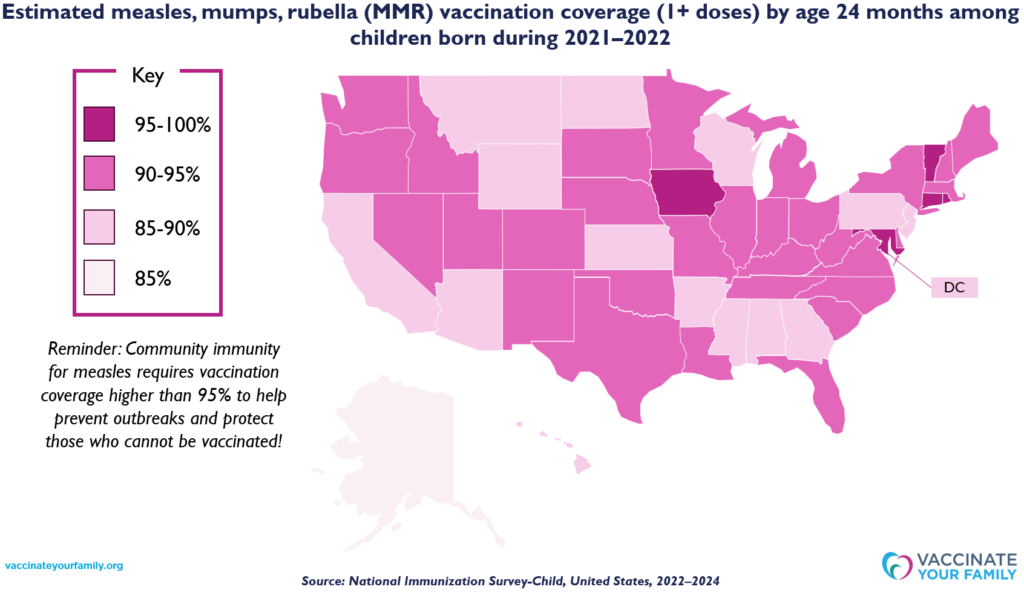
The measles, mumps, and rubella (MMR) vaccination rate need to be at 95% for community immunity. The CDC data reports MMR vaccination rate at 90.8%, which helps explain the ongoing measles outbreaks. A visual of the MMR VCR by state and district is included here.
VCRs were lower for children who are eligible for the Vaccines for Children (VFC) program—a federally funded program that provides vaccines at no cost to over 50% of children in the U.S.
Children living in poverty and rural areas were less protected from vaccine-preventable diseases through immunization. Similarly, compared with non-Hispanic White children, VCRs were lower among non-Hispanic Black children and Hispanic/Latino children.
While VCRs remain high, disparities in coverage are creating an increased risk for outbreaks of vaccine-preventable diseases.
Learn more about why vaccination against these dangerous diseases is important and the Vaccines for Children Program.