There Was No Vaccine To Save Her Son From HMPV, But One Day, There Could Be
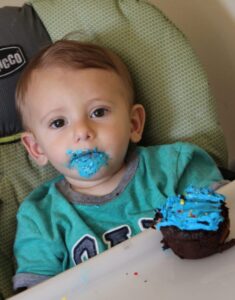
In 2016, Denise lost her healthy, 15-month-old son, Asher, to human metapneumovirus (HMPV). Similar to respiratory syncytial virus (RSV), HMPV is a virus that causes cold-like symptoms. While most people get HMPV before age 5, it can be serious for young children, adults over 65, and people with certain medical conditions.
Read Denise’s story in her own words below.
____
 The weekend after Thanksgiving, my mom called to tell me my dad was in the hospital with heart problems. As the days wore on, I kept asking my mom when I should come. I finally made the decision to leave on Friday, December 9th with my eldest child, arranging for Asher and his other sister to stay home as they were too young to make the trip.
When I arrived at the hospital that Saturday, I spoke with my husband on the phone. He mentioned that Asher had a fever, and he had given him ibuprofen. I talked with him again later that night, and he said Asher had asked him to go to bed early. I went to bed thinking Asher just had a cold and what horrible timing given I wasn’t there to help.
The next day, my husband texted me and asked if I saw the email about a child in Asher’s class potentially having RSV. I had not, but immediately alarms started going off in my head. I had been through RSV with Asher’s sister when she was 7 months old—she spent five days in the hospital.
I asked my husband to count how many breaths Asher was taking per minute, and he said it was 80. I told him that his breathing was too fast, and he needed to take him to the ER. Once he arrived, they put Asher on oxygen and took x-rays. A short while later, they said Asher needed to go to the children’s hospital, but since his oxygen saturation was so low, he needed to be transferred by ambulance.
I often sit in pain wondering what Asher was thinking in that ambulance. He was without his parents, hooked up to machines with strangers. Every time I see an ambulance now, I think of him, and tears come to my eyes.
When Asher arrived at the children’s hospital, the doctors made the decision to intubate him and admit him to the pediatric intensive care unit (PICU). When my husband texted me that they were intubating him, I knew things were really bad and I frantically started looking for flights back home.
 When I first arrived and saw Asher—intubated, connected to machines, a catheter in place, his body exposed—I burst into tears. My poor sweet boy was swollen from fluid retention, which is normal when you are intubated and immobile. I learned that many of the medications Asher was on were the same medications my dad was on, and they both were swollen and retaining fluid. It was a very surreal experience.
After a couple hours of seeing Asher in this state and speaking to his doctor, who assured me that Asher would be okay, I started to adjust. I accepted the reality that Asher was very sick but that in some time this would all be over and he would be home. My husband and I took turns staying the night with him, but the only time my anxiety would lessen was when I was with Asher. I talked to him, read to him, and sang him songs. The nurses said his vitals would stabilize when I talked to him. I don’t know if that was true, but it made me feel good and motivated me to keep going.
On Wednesday, December 14th, it was my husband’s turn to stay overnight with Asher. I went to bed at home, hoping time would pass quickly. Early the next morning, I got a call saying that Asher’s oxygen levels had plummeted, and they needed me to come quickly.
When I arrived, they informed me that the only option to help Asher was extracorporeal membrane oxygenation (ECMO), which is an advanced life support technique used for patients with life-threatening heart and/or lung problems. ECMO provides long-term breathing and heart support and is used only when all the standard treatments for those problems have already been tried.
 The doctor asked my husband and I if we would consent to ECMO for Asher. We were terrified of consenting, and we were terrified of not consenting. We agreed because what else were we to do?
Within a minute the surgery team arrived, and the doctors kept telling me to touch him and say goodbye. I did but I was in shock. For the next two hours, my husband and I sat alone in the waiting room. It was the most agonizing wait I have ever experienced.
Finally, the doctor came back and said the surgery went smoothly. Asher’s oxygen saturation levels were much better, and his vitals had stabilized. Even though Asher’s surgery went well, we were petrified. But surprisingly, by the end of the day, my husband and I had adjusted again to Asher’s current state. It is amazing how human beings can adjust so quickly when tragedy strikes.
The day after the surgery, the staff commented on how easily the ECMO process was going for Asher. We settled in further to his current condition and made plans to be in the hospital for several more weeks. Although Asher’s heart rate started to increase, we were told that it is normal while on ECMO, and they would give him medication to stabilize it.
Early Sunday morning on December 18th, I got a call from my husband to come quickly to the hospital as Asher was in cardiac arrest. Before I got there, my husband texted that they got Asher back and he was stable. When I ran to Asher’s hospital room, it was filled with people. The staff looked scared, which I hadn’t experienced before.
My husband, emotional after witnessing Asher’s heart attack, left to spend time with our daughter while I stayed with Asher. Typically, I would chat with the nursing and ECMO staff in the room, but everyone was silent with serious looks on their faces. Within a minute Asher’s vitals started falling, and a “code blue” was called.
I stood there staring as people started running into his room. Many people started working on him, and a doctor led me to a chair just outside. I called my husband and told him to come back immediately, and a doctor and nurse sat with me while I cried, heaved, and hyperventilated.
After rounds of CPR and final last resorts, everyone stopped. I was amazed at how quickly all the machines were unhooked from Asher. When my husband came into the room and saw Asher, he asked the nurse if it was over. She nodded. He and I clung to each other, taking turns comforting each other as best we could.
 For the next couple hours, we took turns holding Asher, talking to him, soaking him in. After a while, my husband asked if we could leave—he didn’t want to remember Asher this way. I agreed and we quickly packed up his room and I held and kissed Asher one last time.
Walking away from Asher’s room felt so wrong—how could I just leave him there? That isn’t what a mom is supposed to do. I asked one of the nurses to stay with him, because I didn’t want him to be alone. They assured me they would take good care of him. I remember thinking, what does that mean? But at the same time, feeling some comfort.
We drove home in a daze and then began making calls letting everyone know that Asher had died. That day people started showing up at our house. It was all a blur.
______
HMPV has no prevention or treatment. While many people have mild symptoms, HMPV causes a significant number of hospitalizations, especially among young children like Asher who were previously healthy.
Although there is not yet an HMPV vaccine, there are currently products in development, such as a combined RSV and HMPV mRNA vaccine, a combined RSV and HMPV protein-based vaccine, and RSV and HMPV monoclonal antibodies.
For families like Denise’s, research and development is personal. Investing in HMPV research is investing in a future where no other family will have to experience the same heartbreak, where no other parent will have to lose a child to a disease that we can one day prevent. Stories like Denise’s remind us why research and development of products like vaccines and monoclonal antibodies is critical to saving lives and ensuring healthy futures for our children.